Circa Nocturna. Circa is an alternative fashion show run in Melbourne, Australia. It has the honour of being Australia's longest running alt fashion event, and possibly the largest as well (though a little hard to tell - it all depends on how you measure it!).
Circa spawned after the realisation that there was a big alt fashion show in Sydney, but not one in Melbourne.
After briefly being dubbed Nightware, The show was called "Nocturnal Instincts". The Sydney inspiration had been Edge City which was then one of Australia's premier fashion shows, the Mercedes Fashion Week in Sydney. So we decided to hook the show up with a big show in Melbourne. L'Oreal Melbourne Fashion Festival was very happy to have us on board as part of their arts programme.
The show's main point of difference from other catwalk was that it used alternative people and freaks as catwalk models, the people on the catwalk modelling the outfits were the sort of people that would wear the alt fashion, some of them were designers as well.
First show was at a club called Tatou in Melbourne, near Southern Cross Station. It only had space for a little stage, we had about 8 designers. The show did pretty well, thought it really suffered from having a smallish space and a short catwalk. As it was run at a club, the After Party (which was called Gothanistas) started as soon as we cleared the cat walk off the dance floor.
The second show in 2006 expanded out to a larger space. We opted for using a comedy Venue. This was a massive venue, capable of holding about 700 people, however, being a comedy venue, there was only backstage space for a couple of comedians to hang out in a little room and have a few pre show cigarettes. We had to build another area by hiring in temporary walls for all the models to get changed. This was expensive, but the night was still successful. The after party was held at the club.
By this stage we were looking to move away from a Goth specific theme, and were looking at showing off all types of alternative fashion. The name was changed to Circa Nocturna to reflect this. By 2007 we had outgrown Clubs and after much hunting around, decided to move it up a notch and get a larger venue, more suited for shows. We ended up at Northcote Town Hall. This was a great venue, had a small hall next to it which we used for practice, and had quite a nice bar. It was also quite close to where a lot of us lived. The only thing was, we were worried that moving the show out of the city into the North may damage it. We shouldn't have worried...the people followed. The show had grown to about 12 designers at this stage. This was the first year we experimented with a market, three of the designers set up tables in a room outside the show. Once again, the show was quite successful.
For the 2008 show we decided to move to another venue, the Fitzroy Town Hall. This also was a great venue, and we liked it so much we have been there ever since. I had been trying to get it for years, and it was always being renovated - so as soon as it was available we booked it. The 2008 show saw us split the designers into two groups, the established and the new designers. We also offered a prize to the best new designer.
2009 once again saw us use the same venue. By this stage we were getting some top nothc designers, including our first Foreign designer from Russia. We were also starting to get designers from all over Australia, with designers fly in from Perth and Brisbane and Canberra to be in the show. The 2009 show was once again a success and very popular, the after party being held at a nearby club. The day after the show a market was held, entitled Carnivale Nocturna - this was the first time we had done a second event. It was held the Sunday after the show, and while was moderately well attended, not as well attended as we hoped.
By this stage, the organising committee formed into Non Profit Incorporated Association. This mean the show became non profit, but we weren't doing it for the money anyway, and the Incorporate Assoc status protected the Managing Committee in terms of liability.
2010 was a brilliant show, and the first time a Catwalk wasn't used. Instead, the models walked on the floor. Raised seating was brought in so the audience could still see the models. The stage was set up with antiques fitting the era of the actual Fitzroy Town Hall itself (which dates to the mid 1800's).
And so, on to 2011!
Tuesday, September 7, 2010

Friday, June 11, 2010
Nasir Mazhar
To call him a Milliner is probably a bit of an understatement. I have seen him described as a "Headwear designer"..which while vagueish, I think encompasses more of what he does. Nasir Mazhar designs go beyond the norm when it comes to hats....quite far beyond the norm.
And that is why he is he on the alt fashion blog.


Nasir Mzhar started doing hair at Vidal Sasson.He sought to extent what he was doing with the hair, by adding forms and peices to the hair to create structures that started to develop a life of their own. Teh structures very soon became headwear, irrespective of the hair itself, and he made the transition from cutting to sculpting wondrous pieces for the head.
Like a lot of designers (eg Galliano) he sees the importance of historical fashion, in this case the historical development of modern hats.
At only 26 years old, Mazhar has worked with the who’s-who of London’s fashion and Entertainment talents, including Mark Wheeler, Kylie Minougue, Gareth Pugh, Richard Nicoll and the Royal Opera House. He has even worked with historical headwear at the Globe Theater.
Most recently he did the headwear, a Borg-ish/steampunkish headpeice, with working retracting eyepieces, worn by Lady Ga Ga's in the filmclip for her latest tune Alejandro (or is it her song for her filmclip?)
Wednesday, May 12, 2010
Vale Alexander McQueen

Alexander McQueen was not an alt fashion designer. Being the head designer at Givenchy, working at Gucci, and then starting his own label..he was in the mainstream side of fashion and very successful at it. However, his work, in my opinion had a cheekiness to it, an edge that was very similiar to the kind of spirit that alternative fashion has. And this most prominently in his catwalk stuff.
Reading about subcultural influence on fashion, McQueen's name is often mentioned as taking influence from goth fashion in particular (as is Gaultier's) for his catwalk range.
McQueen's catwalk shows were famous for their blitzkrieg effect, innovation and outrageousness. In particular the talk about his shows will no doubt recall the hats he used for his 2009 Paris show, his models wearing a Borat inspired Mankini in 2006, the use of huge 12 inch stilettos on the catwalk, Aimee Mullins the amputee model or his famous low slung Bumster jeans.
He also employed cute technology, inlcuding a hologram of Kate Moss taking to the runway for his "Widows of Culloden" show in 2006. And, possibly borrowing from Goth subculture, his use of skulls in fashion became famous and was copied widely. As Karl Lagerfeld said of him: “There was always some attraction to death, his designs were sometimes dehumanized.”
In particular, some of his use of metal couture was very inspiring. McQueen went out of his way to find interesting British artisans/designers to help accessorise his catwalk designs.
Vale Lee Alexander McQueen. The only consolation to your loss to this world is that you leave behind many people who you have inspired over the years with your fantastic, irreverent and ingenious work.

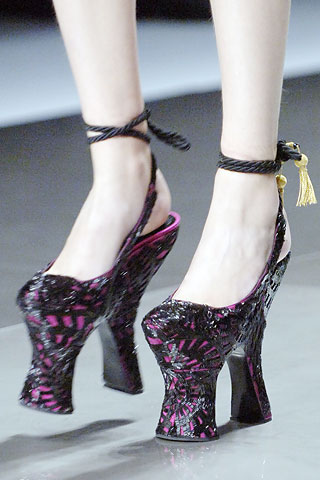
Apologies for no recent posts...
Sorry - had some time off having a baby - will be getting back to writing about alt fashion shortly.
And my god, I will have to start filtering the comments, to get rid of the dodgy spam posters. Curse them!
And my god, I will have to start filtering the comments, to get rid of the dodgy spam posters. Curse them!
Thursday, February 11, 2010
Skinhead Fashion

(promotional pic for "This is England') Two guys on the left are Rude boys.
It is interesting how close the Rudie look is to the skinhead look, but still they are quite different in a lot of ways.
Skinhead fashion is the fashion that, out of all subcultural fashion, comes across as the most aggressive visually. It certainly makes a statement...particularly when a big group of them appear in the pub!
Subcultural fashion tends to speak for its wearer. People wearing subcultural fashion make statements through what they wear. Skinhead fashion is practical and certainly conveys a look that is functional and hard.
Tight jeans, Big Doc Marten boots, short hair, all very practical.
That said, traditionally skinhead fashion in the 60's, coming out of the hard mod look, also had its stylish side. Early skins, and modern sharp dressing skins, wear suits, Ben Shermans and much of the sophisticated mod look when dressing to impress.
If you want more detail......The quintessential book about skins, including lots of fashion development, is this...

"Skinhead" by Nick Knight.Its a bit old now, but has great detail on the evolution of the subculture, philosophy and some great photography. Also, "This is England", "Skinhead Attitude" and "Romper Stomper"
Monday, January 4, 2010
Doctor Martens
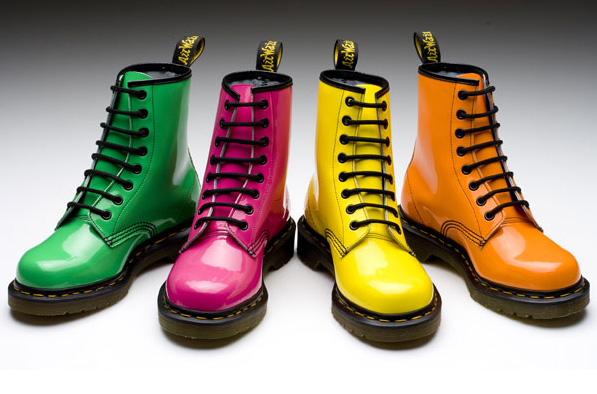 Patent leather docs
I remember about 20 years ago....the only people that wore Dr Martens were skinheads. The only people who knew what they were were skinheads. Now most alt fash people (at least) know what they are, and many people have bought a pair....or have at least considered
Sydney in 1985. Spending $70 on a pair of boots was unheard of. But we did. Our parents couldn'
t believe it. And that was just the ordinary 8 hole ones. You could only buy them in one or two disposal stores in the city, who imported them and sold them to Skinheads. Then Rude boys got in on it, then a few mods, and then they seem to generally get out into the alt community. Punks I think started switching over from GPs eventually.

Standard Cherry reds
The concept of a group of rough and ready Skinheads or punks wearing $90 imported English footear, at the time when $90 was a lot of money, was pretty contradictory. Dr Martens were the rough and ready, working class, boot. In the UK they were anyway, they were an affordable, attainable, workboot. In Australia they were expensive, but they were the cool thing to wear, so we did..and we liked them.
Originally Dr Martens came in 8 and 10 holes, and usually were black or Cherry red. People wore white or red shoelaces in them. Some said this meant something about racism or something, but I think most people weren't too fussed. I (I was a rude boy) had one pair of 10 hole boots, black with white laces. Some "normal" friends thought they were wrestling boots.
We would wear doc shoes to work, and people would assume we were wearing our shoes leftover from school.
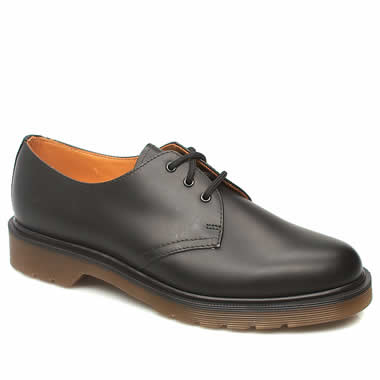 I wore these for years. Hmmmm *rubs chin* Actually, may be I will get some new ones for work....damn, writing this blog can be expensive!
Slowly by the 90's they became general alternative footwear. My mate was going travelling through Europe - I was suprised to see him wearing a pair of the new ones, without the traditional sole, but with a big chunky hiking sole...some kind of Doc-hiking boot hybrid thing.
Heresy.

The variation of docs got wider. Doc shoes. Doc sandals. Doc shoes with polished steel caps on the outside. Union Jack Docs. PurpleFelt docs. Patent leather docs. Green docs.
Some people would paint them or do their own mods on them.
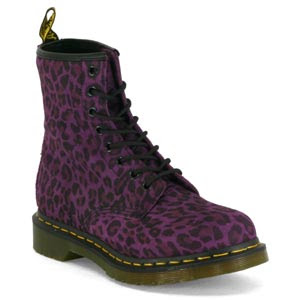 Purrple leapard skin felt
Docs have air wear soles. So they have little compartments of air in the soles. The standard of docs seem to vary, some people had had them for years. Sometimes the leather would crack. Sometimes they would wear down too quickly.
I remember I used to think Docs were the big clumpy boot. Until I saw New Rocks.
I paint in an old pair of mine now, when I do my home renovations. Must be getting old :-)
Thursday, December 17, 2009
The very stylish Dave Vanian
Dave Vanian has been in the music world limelight since 1976.
Vanian is a bit of living subcultural fashion. Being one of the original goth lead singers to get a profile, he provided a leading influence on goth subcultural fashion. What he wore, really influenced what a lot of goths wore in the 1980's, and still wear to this day (especially the more traditional styled goths).
Anyways, some pics of Dave Vanian through the years, in his own inimitable style.
 The original vampire esque look (late 1970's - early 80's).
 The hair, the white streak. Classic Damned and classic Dave Vanian (mid 1980's, the era of teased hair!)
 Lately (2005)
Dave Vanian, along with Siouxsie Sioux and Robert Smith, would probably be the triumvirate mainly responsible for influencing goth fashion, particularly in its early days.
Video of him singing Eloise.... so much white!
http://www.youtube.com/watch?v=b31L4P7G5j8&feature=fvsr
Mr Vanian, a toast to thee!
Vanian is a bit of living subcultural fashion. Being one of the original goth lead singers to get a profile, he provided a leading influence on goth subcultural fashion. What he wore, really influenced what a lot of goths wore in the 1980's, and still wear to this day (especially the more traditional styled goths).
Anyways, some pics of Dave Vanian through the years, in his own inimitable style.
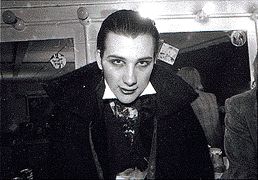 The original vampire esque look (late 1970's - early 80's).
 The hair, the white streak. Classic Damned and classic Dave Vanian (mid 1980's, the era of teased hair!)
 Lately (2005)
Dave Vanian, along with Siouxsie Sioux and Robert Smith, would probably be the triumvirate mainly responsible for influencing goth fashion, particularly in its early days.
Video of him singing Eloise.... so much white!
http://www.youtube.com/watch?v=b31L4P7G5j8&feature=fvsr
Mr Vanian, a toast to thee!
Subscribe to:
Posts (Atom)